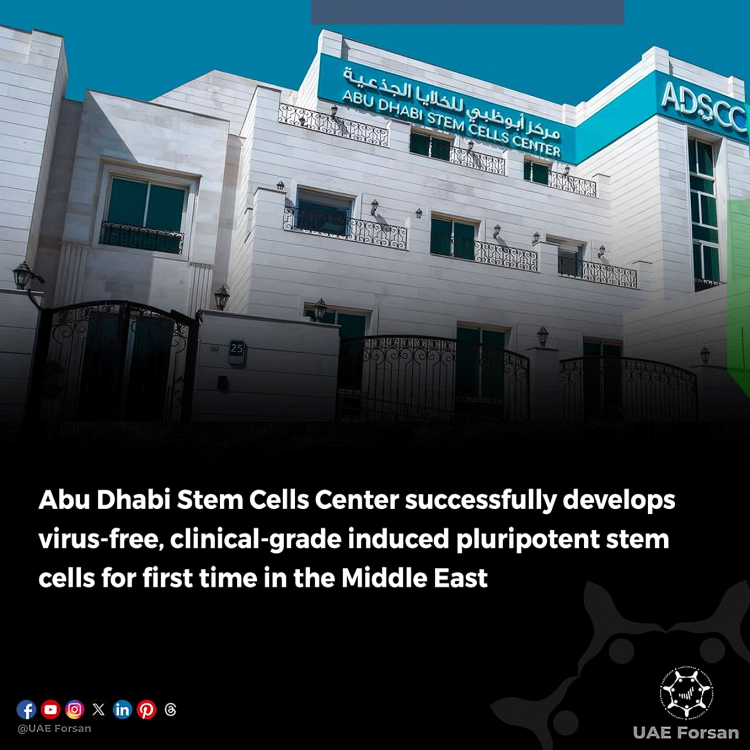
In a groundbreaking milestone for regenerative medicine and cell therapy, the Abu Dhabi Stem Cells Center (ADSCC) has successfully developed clinical-grade induced pluripotent stem cells (iPSCs). These iPSCs, crafted through ADSCC’s proprietary virus-free protocols, meet stringent Good Manufacturing Practice (GMP) standards, positioning them as the first of their kind in the Middle East to comply with international clinical standards. This achievement underscores ADSCC’s leadership in stem cell research, setting a new global benchmark for precision medicine.
A Leap Forward in Therapeutic Applications
iPSCs represent a revolutionary tool in biomedical science, offering potential treatments for conditions like Parkinson’s disease, Alzheimer’s disease, multiple sclerosis, and diabetes. At ADSCC, ongoing research aims to harness iPSCs for these diseases, leveraging their unique capability to differentiate into various human cell types.
Derived from reprogrammed adult cells, such as skin or blood, iPSCs revert to an embryonic-like state, enabling the creation of autologous therapies tailored to individual patients. These personalized approaches minimize immune rejection risks and reduce dependency on immunosuppressive drugs.
A Visionary Approach
Professor Yendry Ventura, CEO of ADSCC and Principal Investigator of the Capital Organ Regeneration (CORi) project, highlighted the significance of this achievement:
“Developing our own clinical-grade iPSCs using a proprietary, virus-free protocol is a monumental step for the UAE and the global medical community. This accomplishment reinforces Abu Dhabi’s position as a hub for cutting-edge medical research and opens doors to transformative therapies for complex diseases. Our findings will soon be shared in leading medical journals.”
Unlike conventional methods that utilize viruses for reprogramming, ADSCC’s virus-free approach eliminates genetic modification, significantly reducing risks such as cell transformation or tumor formation. This adherence to strict clinical standards ensures the iPSCs’ suitability for therapeutic applications, marking a substantial advancement in regenerative medicine.
Regional and Global Impact
Professor Angelo Vescovi, Advisor at ADSCC and of Link Campus University in Rome, emphasized the clinical potential:
“Induced pluripotent stem cells are the cornerstone of personalized medicine. For example, iPSCs can be differentiated into neural stem cells for neurodegenerative diseases or pancreatic cells for diabetes, with improved safety and reliability. This innovation paves the way for transformative therapies.”
By establishing an exclusive in-house protocol, ADSCC ensures superior control over the production of clinical-grade iPSCs, enhancing accessibility to these life-changing therapies while reducing reliance on external sources.
Aligning with UAE’s Vision for Healthcare Innovation
ADSCC’s success reflects the UAE’s commitment to becoming a global leader in healthcare innovation. Equipped with advanced GMP facilities and a skilled research team, the center is poised to turn this breakthrough into tangible patient treatments.
“This accomplishment is not just about scientific excellence; it’s about offering hope to patients suffering from debilitating diseases,” said Professor Ventura. “The potential applications span from neurological treatments to chronic illness therapies, soon to be available at our Abu Dhabi hospital.”
International Collaboration
In December 2023, ADSCC partnered with Kyoto University’s Center for iPS Cell Research and Application (CiRA) and Japanese biotech firm Rege Nephro. This collaboration aims to develop diabetes treatments using iPSC-derived pancreatic beta cells. Joint research efforts are underway in Abu Dhabi and Japan, with a dedicated laboratory established at Kyoto University.
ADSCC’s groundbreaking work sets a foundation for transformative advances in healthcare, bringing hope to countless patients worldwide and further cementing Abu Dhabi’s reputation as a hub for cutting-edge medical research.