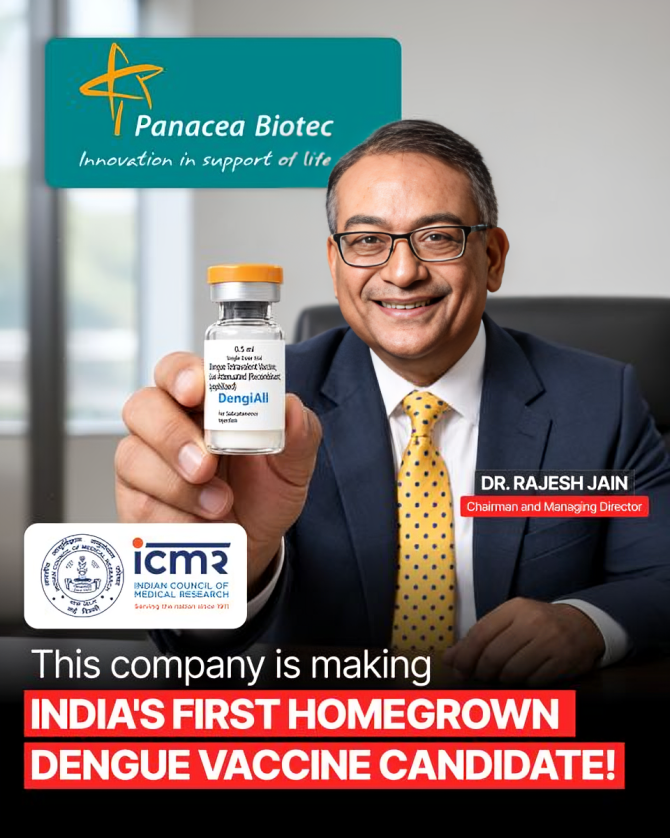
India is advancing the development of its own dengue vaccine as homegrown candidate DengiAll moves through Phase III clinical trials, potentially adding a domestically developed option to the country’s efforts to address the growing burden of dengue.
The development comes less than two months after India approved QDENGA, a dengue vaccine developed by Japan-based Takeda and marking the country’s first approval of an imported dengue vaccine.
DengiAll is being developed by Panacea Biotec, a New Delhi-based biotechnology company, in collaboration with the Indian Council of Medical Research (ICMR).
According to ET Pharma, the Phase III trial is being conducted across approximately 20 institutes, with more than 13,000 volunteers enrolled. The study is expected to remain blinded until the end of 2027, when researchers aim to begin unblinding and assessing the trial outcomes.
A Tetravalent, Single-Dose Approach
DengiAll is designed as a tetravalent dengue vaccine, targeting all four recognized dengue virus serotypes in a single dose.
The candidate is based on the TV003/TV005 tetravalent dengue vaccine strains, originally developed by the U.S. National Institutes of Health (NIH). Panacea Biotec licensed the strains in 2006 and subsequently developed an Indian vaccine formulation.
The company completed Phase I and Phase II clinical development during 2018–19 before progressing toward the current Phase III program.
The single-dose approach is another distinguishing feature of DengiAll, particularly as dengue vaccination strategies globally have included vaccines requiring more than one dose.
Why Dengue Vaccine Development Is Complex
Dengue presents a particularly challenging vaccine-development landscape because infection can involve four major serotypes—DENV-1, DENV-2, DENV-3 and DENV-4.
Protection against one serotype does not necessarily provide equivalent protection against the others. In addition, the relationship between prior infection, antibodies and subsequent infection with another serotype has made vaccine safety and efficacy particularly important considerations in dengue vaccine development.
That makes large-scale Phase III evidence critical before a candidate such as DengiAll can be considered for widespread use.
Potential Significance for India
If DengiAll successfully completes Phase III testing and subsequently receives regulatory approval, it could provide India with a domestically developed dengue vaccine, while potentially strengthening local manufacturing and supply capacity for a disease that places a recurring burden on the country’s healthcare system.
For India, the development also reflects a broader push toward strengthening domestic vaccine research, biotechnology capabilities and pharmaceutical manufacturing.
However, the vaccine’s eventual public-health role will depend on the results of the ongoing clinical trial, regulatory assessment and evidence regarding its safety, efficacy and real-world performance.
As dengue continues to pose a significant seasonal and public-health challenge, the progress of DengiAll will be closely watched—not only by India’s healthcare sector, but also by the wider global vaccine-development community.