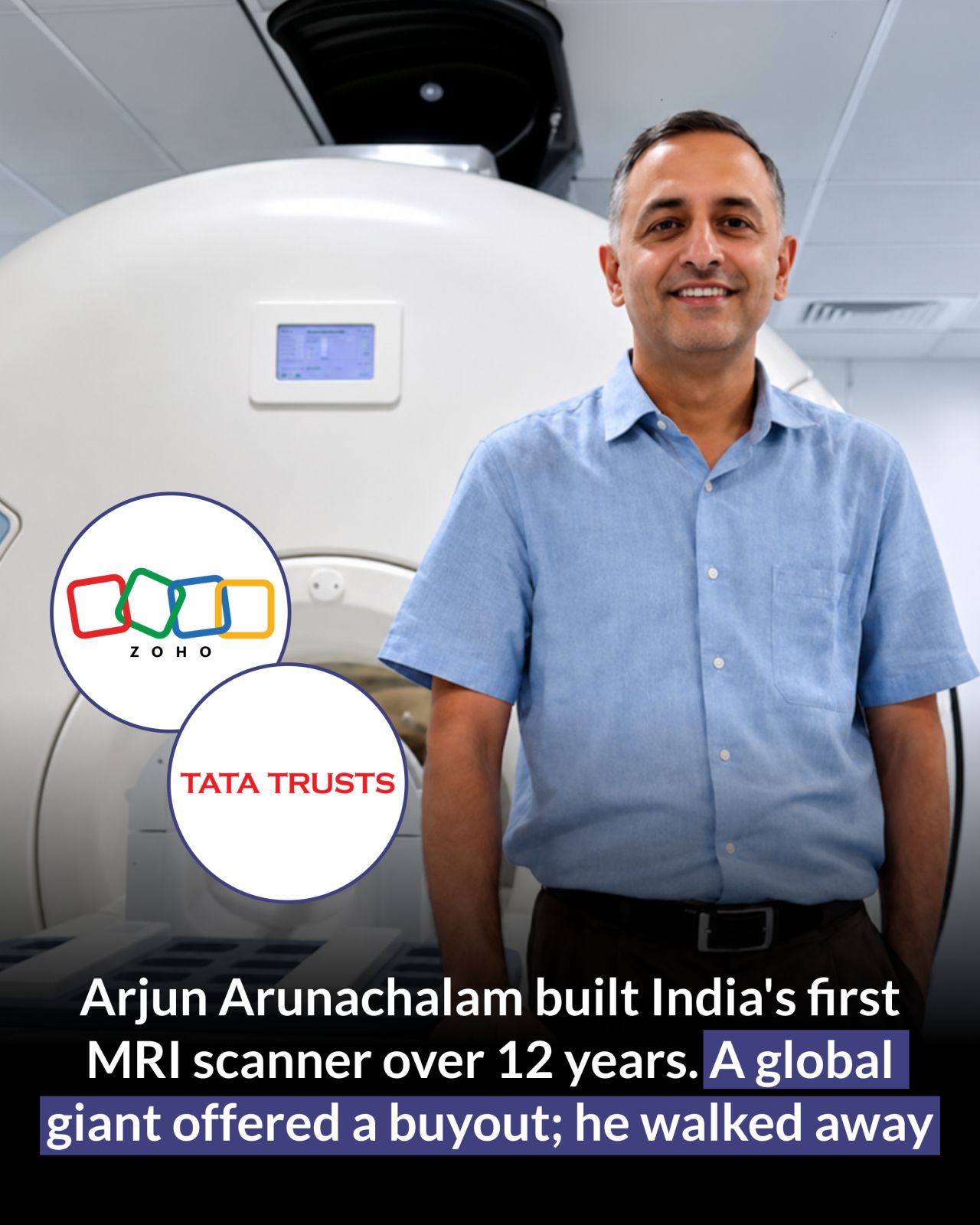
Bengaluru-based Voxelgrids is developing an indigenous MRI scanner that could lower scanning costs by up to 70%. Founder and CEO Arjun Arunachalam says support from Tata Trusts and Zoho helped the company continue developing its technology rather than accept a buyout offer from a global medical technology giant.
For decades, the global Magnetic Resonance Imaging (MRI) market has been dominated by a handful of multinational medical technology companies. Developing an MRI scanner requires substantial investment, advanced expertise and years of research spanning physics, electronics, software and precision engineering.
For Bengaluru-based Voxelgrids, entering this highly concentrated market was never going to be easy.
Yet founder and CEO Arjun Arunachalam chose to take on the challenge of developing an indigenous MRI scanner for India—despite competing with companies with billions of dollars in resources.
At one point, during the Covid-19 pandemic, Voxelgrids was approached by a multinational company with an offer that could have provided the cash-strapped startup with an easier path forward.
Arunachalam declined.
According to him, the concern was that partnering with a global giant could ultimately compromise the independence and innovation that Voxelgrids was trying to build.
“We thought partnering with the company would risk our innovation,” Arunachalam told India Today Digital.
The decision was made possible, in part, by financial support from Tata Trusts and later Zoho founder Sridhar Vembu, which helped the startup continue its development independently.
Building an MRI Machine From Scratch
MRI scanners are among the most technologically demanding medical devices. Arunachalam understood the complexity before starting Voxelgrids.
An electrical engineer specialising in MRI physics, he studied at the University of Wisconsin-Madison in the US and subsequently spent nearly three years at GE HealthCare’s research centre in the country around 2008-09.
That experience gave him first-hand exposure to MRI research and development.
Later, after moving to Singapore and briefly teaching at IIT Bombay, Arunachalam became increasingly frustrated by the lack of access to MRI technology for researchers in India.
He wanted to conduct research and develop innovative MRI technologies, but access to machines was limited.
According to Arunachalam, international MRI manufacturers also showed limited interest in collaborating with Indian institutions at the time.
That experience eventually led him to pursue a larger goal: building MRI technology in India rather than simply importing it.
Why India Needed an Indigenous MRI Manufacturer
India remains heavily dependent on imported medical imaging equipment.
Arunachalam estimates that India imports MRI-related products worth approximately Rs 3,500 crore annually.
The high cost of acquiring, installing and maintaining imported MRI systems also contributes to the expense of diagnostic imaging.
An MRI scan in India can cost around Rs 10,000, although prices vary significantly depending on the type of scan, location and healthcare facility.
Arunachalam argues that the country has significantly greater demand for MRI services than current availability suggests.
According to him, India has nearly three times as many CT scanners as MRI machines, with the cost and complexity of MRI systems being important factors behind the disparity.
“There is a global product-fit issue with MRI machines,” he said.
For Voxelgrids, the objective was therefore not simply to create another MRI scanner, but to develop a system better suited to India’s cost and infrastructure requirements.
From MRI Software to a Complete Scanner
Voxelgrids did not initially set out to manufacture an entire MRI machine.
The company originally wanted to focus on MRI imaging software and intellectual property.
However, according to Arunachalam, working with existing MRI manufacturers presented significant limitations. Instead of being able to freely develop and integrate its technology, the startup encountered commercial and technological restrictions around its intellectual property.
The company eventually made a much bigger decision: build its own MRI system.
Voxelgrids began developing the technology in-house, covering software, electronics and other critical components.
What began with a four-member engineering team has since grown to around 33 people, according to Arunachalam.
The company believes its MRI system could eventually be approximately 40% cheaper and 50% lighter than conventional systems, potentially reducing installation and operating costs.
However, the technology remains at an early stage and Voxelgrids’ MRI scanners are not yet commercially available.
Tata Trusts Backed the Vision
Financing was one of the biggest challenges facing Voxelgrids.
Arunachalam says Tata Trusts was the first major organisation to believe in the company’s vision.
He first approached the organisation in 2015. At the time, Ratan Tata was actively involved with Tata Trusts.
Arunachalam was invited to Mumbai after the Trusts showed interest in the technology.
He subsequently met Ratan Tata twice.
According to Arunachalam, Tata was particularly interested in technologies that could contribute to India’s development.
The support became even more significant during the Covid-19 pandemic, when Voxelgrids was struggling financially.
Arunachalam continued updating Tata Trusts about the company’s progress. Eventually, another meeting was arranged with the assistance of Ratan Tata’s then personal secretary, Delnaz Gilder.
Tata Trusts ultimately supported the company through what Arunachalam describes as an order for its MRI machine—even though Voxelgrids did not yet have a commercially available product.
“We didn’t have a product, and Ratan Tata had provided us with orders. That’s how great and humble he was. I’m so grateful,” Arunachalam told India Today Digital.
How Sridhar Vembu and Zoho Entered the Picture
Tata Trusts’ support helped Voxelgrids through a crucial phase, but the startup still needed capital to complete the development of its complex medical technology.
Government support, including funding through the National Biopharma Mission, also helped sustain the project.
Another significant development came in 2021, when Arunachalam was introduced to Sridhar Vembu, founder of Zoho.
Vembu, himself an electrical engineer, understood the technical difficulty involved in building an MRI system and the broader significance of developing such technology in India.
Arunachalam says Vembu recognised the scale of the challenge but was willing to support the company despite the uncertainty.
The investment provided Voxelgrids with additional financial runway while allowing the company to continue developing its technology independently.
Why Voxelgrids Rejected the Multinational Offer
For a startup developing one of the world’s most complex medical devices, a buyout offer from a multinational could have been an attractive proposition.
But Arunachalam believed that accepting such an offer could undermine the company’s original objective.
He argues that established global manufacturers have significant financial resources and understand how difficult it is for smaller companies to survive in MRI manufacturing.
“We had no interest in partnering with a bigger firm,” he said.
Instead, Voxelgrids chose to remain independent and pursue the slower, more difficult route of developing its own technology.
That approach has required the company to operate cautiously, manage capital carefully and accept a longer development timeline.
“People ask why it is taking longer,” Arunachalam said. “That is exactly how we are building a cheaper machine.”
Can Voxelgrids Transform MRI Access in India?
Voxelgrids’ technology is still progressing toward commercialisation, so its promised cost reductions and performance advantages will ultimately need to be demonstrated at scale.
But the company’s ambition represents a larger question for India’s healthcare sector: Can indigenous medical-device manufacturing reduce India’s dependence on imported technology while making advanced diagnostics more accessible?
If Voxelgrids successfully brings its MRI system to market, the impact could extend beyond Bengaluru.
A lower-cost, lighter MRI scanner could potentially make installation more viable for smaller hospitals, diagnostic centres and healthcare facilities outside India’s major metropolitan areas.
For Arunachalam, however, the objective is bigger than building a single machine.
It is about demonstrating that India can develop sophisticated medical technology domestically—and potentially make advanced diagnostic care more accessible to millions of patients.
For The Health Colossus, this story highlights a critical healthcare-business trend: the growing importance of indigenous medical-device innovation, patient affordability and technology designed specifically for emerging-market healthcare systems.