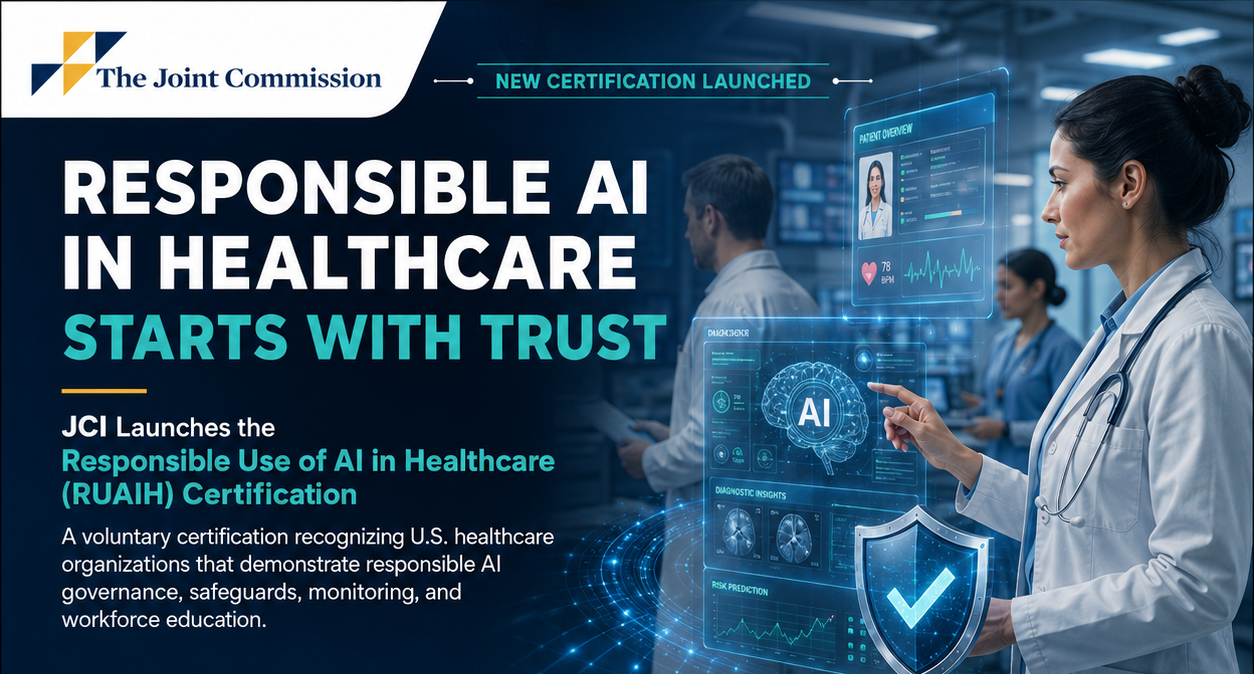
As artificial intelligence continues to reshape healthcare delivery, the Joint Commission has launched the Responsible Use of AI in Healthcare (RUAIH) Certification, a first-of-its-kind voluntary program designed specifically for U.S. healthcare organizations. The certification recognizes organizations that have established the governance, safeguards, monitoring processes, and workforce education necessary to deploy AI responsibly and ethically in healthcare settings.
Healthcare organizations across the United States can now apply for the certification, regardless of whether they are currently accredited by the Joint Commission. The initiative aims to provide a structured framework for the safe, reliable, transparent, and ethical use of AI while addressing critical concerns related to patient safety, privacy, bias, and accountability.
Supporting Safe, Ethical, and Trustworthy AI Adoption
AI technologies are increasingly being integrated into clinical, operational, administrative, and care-support workflows. From improving diagnostic accuracy and personalizing treatment plans to enhancing operational efficiency, AI offers significant opportunities to transform healthcare delivery. However, its rapid adoption also introduces challenges related to governance, data security, transparency, and risk management.
The RUAIH certification is designed to help healthcare organizations balance innovation with accountability by establishing standards across five key domains:
- Governance
- Effective data management
- Risk and bias reduction
- Monitoring, evaluation, and validation of AI performance and safety
- Transparency, education, and workforce training
A Framework for Responsible AI Governance
According to the Joint Commission, the certification evaluates whether organizations have established formal governance structures, AI policies, data protection mechanisms, risk mitigation processes, safety monitoring systems, reporting protocols, and staff education programs. Importantly, the certification focuses on organizational AI governance rather than certifying individual AI products or technologies.
Leadership Perspective
Highlighting the transformative potential of AI in healthcare, Jonathan B. Perlin, MD, PhD, President and CEO of the Joint Commission, stated:
“AI has the potential to unlock advances we have yet to envision in the healthcare space. With this new certification, Joint Commission is providing healthcare organizations with the blueprint for safely and appropriately using AI.”
Perlin also emphasized the growing need for standardized AI governance, noting that the increasing use of AI by healthcare professionals underscores the importance of implementing universal frameworks for responsible adoption.
Why It Matters
The launch of RUAIH marks an important milestone in healthcare’s AI journey. As health systems continue to invest in AI-driven solutions, the certification offers a practical pathway for organizations to demonstrate their commitment to patient safety, ethical innovation, transparency, and public trust. By establishing clear governance and oversight mechanisms, healthcare leaders can better harness AI’s benefits while mitigating emerging risks.
The Health Colossus Insight: As AI transitions from experimental applications to enterprise-wide deployment, governance frameworks such as RUAIH could become a critical differentiator for healthcare organizations seeking to build trust, ensure compliance, and deliver safe, patient-centered innovation at scale.