
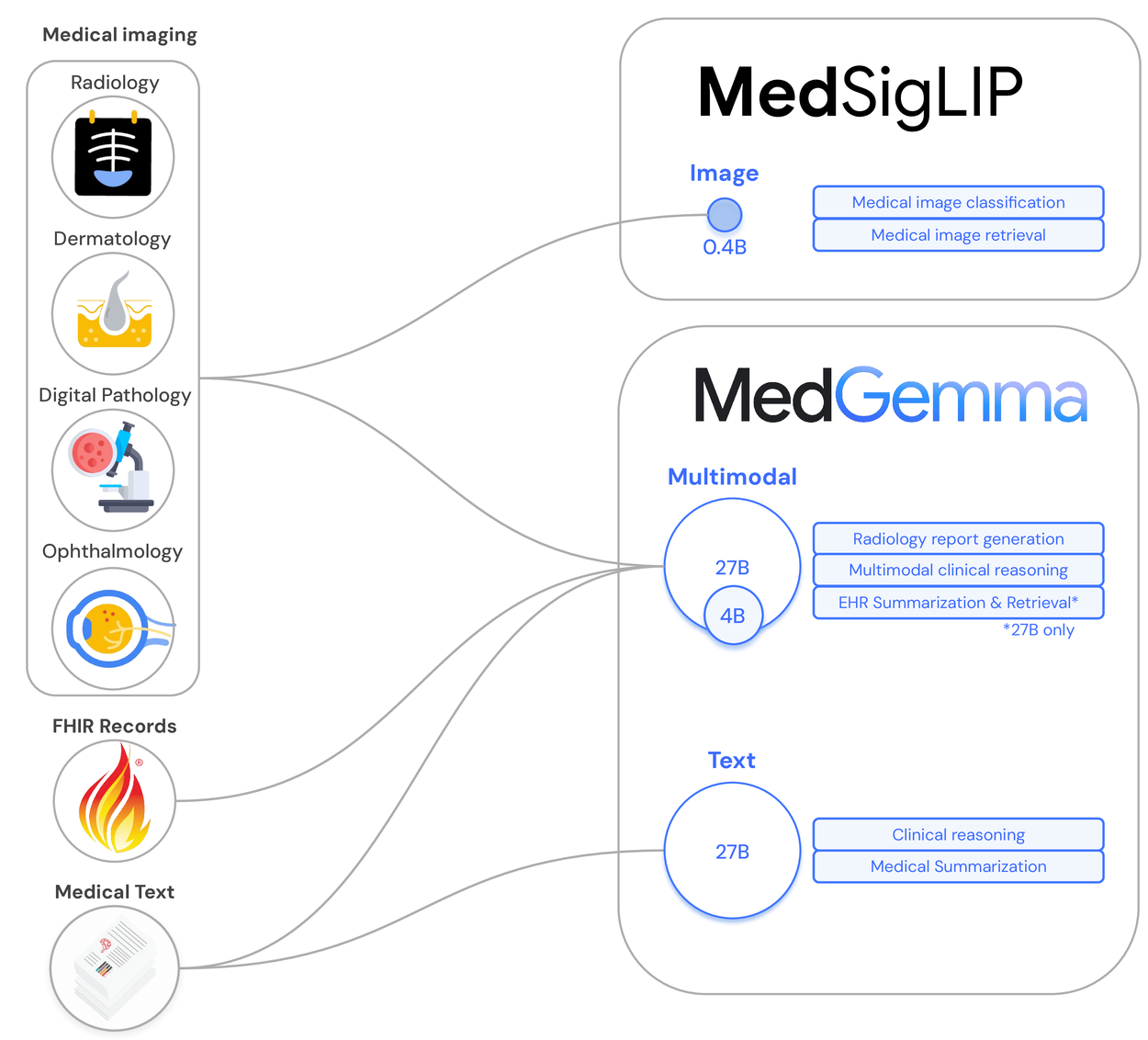
The evolution of healthcare AI continues to accelerate, with a growing emphasis on models that are not only high-performing but also efficient, adaptable, and privacy-conscious. In this context, Google has expanded its Health AI Developer Foundations (HAI-DEF) portfolio with new additions to the MedGemma collection—its most advanced open models for healthcare and life sciences AI development.
HAI-DEF was designed as a suite of lightweight, open models that give developers greater control over deployment, privacy, and customization—key requirements in clinical environments. Building on this foundation, MedGemma, introduced earlier this year, leverages the Gemma 3 architecture to support a wide range of healthcare applications, from diagnostics to workflow optimization.
New Multimodal Capabilities
The latest release introduces two new models:
- MedGemma 27B Multimodal: Extending beyond text-only capabilities, this model enables advanced interpretation of multimodal and longitudinal electronic health records (EHRs), supporting more comprehensive clinical insights.
- MedSigLIP: A lightweight image-text encoder designed for classification, search, and retrieval tasks. It shares the same image encoding backbone used in existing MedGemma models, ensuring consistency across applications.
These additions strengthen the MedGemma ecosystem, enabling both generative and structured-output use cases—from clinical report generation to medical image classification.
Performance and Efficiency at Scale
MedGemma models are positioned as practical tools for real-world deployment:
- MedGemma 4B Multimodal delivers strong performance among compact models, achieving 64.4% on the MedQA benchmark. In clinical evaluation, 81% of AI-generated chest X-ray reports were deemed sufficiently accurate by a board-certified radiologist to support comparable patient management decisions.
- MedGemma 27B variants demonstrate competitive performance among sub-50B models. The text-only version scores 87.7% on MedQA, approaching leading models like DeepSeek R1—while operating at roughly one-tenth of the inference cost.
Importantly, all models can run on a single GPU, with smaller variants capable of adapting to mobile hardware—highlighting a shift toward scalable, cost-efficient AI deployment in healthcare settings.
Implications for Healthcare Systems
The MedGemma expansion reflects a broader industry shift toward open, flexible AI ecosystems. By enabling multimodal understanding and reducing computational barriers, these models could accelerate innovation across clinical decision support, radiology workflows, and patient communication tools.
For healthcare leaders, the focus is no longer just on AI capability—but on deployability, governance, and cost-efficiency. Open models like MedGemma offer a pathway to balance these priorities while maintaining control over sensitive health data.